Building Safety Capacity in a VUCA World
Why sensemaking, human performance and psychological safety now define operational resilience
February 23, 2026
By: Brian Wilson
Volatility, uncertainty, complexity and ambiguity (VUCA) are no longer occasional disruptions to industrial operations. They are the prevailing conditions under which work is planned, executed and judged. From fluctuating production targets and constrained workforces to aging assets, climate variability and evolving regulatory expectations, organizations are operating in an environment where stability is the exception rather than the rule.
A persistent assumption still shapes many safety strategies: that tighter controls, more detailed procedures and stricter compliance will deliver safer outcomes. That assumption no longer holds under VUCA conditions. When situations evolve faster than procedures can be updated, safety depends less on rigid adherence and more on an organization’s capacity to adapt safely in real time.
That capacity rests on three interconnected elements: sensemaking, human performance modes and psychological safety. Together, they determine whether people can recognize emerging risk, respond effectively and learn from normal work as well as failure.
VUCA and the limits of traditional safety thinking
The term VUCA emerged from the U.S. Army War College to describe the strategic uncertainty of the post–Cold War world. In industrial and infrastructure settings, its relevance is even more tangible. Daily operations are shaped by shifting priorities, competing objectives, incomplete information and unexpected interactions between technical, human and environmental systems.
Traditional safety models have delivered significant gains by focusing on standardization, hazard identification and incident prevention. These approaches work best when tasks are repeatable and conditions are predictable. Under VUCA conditions, however, they reveal a critical limitation: they assume work unfolds as imagined rather than as actually performed.
In practice, variability is unavoidable. The same task carried out by the same person using the same procedure can produce different outcomes depending on timing, workload, system state and external pressures. Treating variability solely as a problem to eliminate obscures its other role: variability is also how systems remain productive and safe when conditions change.
Reframing safety as a dynamic capacity rather than a static outcome shifts the focus. The question becomes not only how to prevent failure, but how to enable people and systems to succeed across a wide range of conditions.
Sensemaking: how work gets oriented under uncertainty
At the core of adaptive performance is sensemaking. Sensemaking describes how individuals and teams notice cues in their environment, interpret what those cues mean, act on that interpretation and then adjust based on the results. It is an ongoing, iterative process rather than a single decision point.
In high-hazard operations, workers rarely encounter textbook scenarios. Procedures can define expected steps, but they cannot fully anticipate degraded equipment, subtle process deviations or conflicting signals from multiple indicators. Operators therefore rely on experience, pattern recognition and continuous feedback to orient themselves.
Sensemaking matters for three reasons. First, variability is inherent in real work. Repeating the same actions does not guarantee the same outcome when conditions differ. Second, ambiguity persists even in well-documented systems. Procedures often specify what to do without fully explaining why, leaving gaps when conditions fall outside assumptions. Third, adaptation is essential for survival. Safe performance frequently depends on timely adjustments made under pressure.
Organizations that overlook sensemaking tend to interpret deviations as noncompliance rather than as attempts to reconcile competing demands. By contrast, organizations that study how people make sense of complex situations gain insight into where systems support adaptation and where they constrain it.
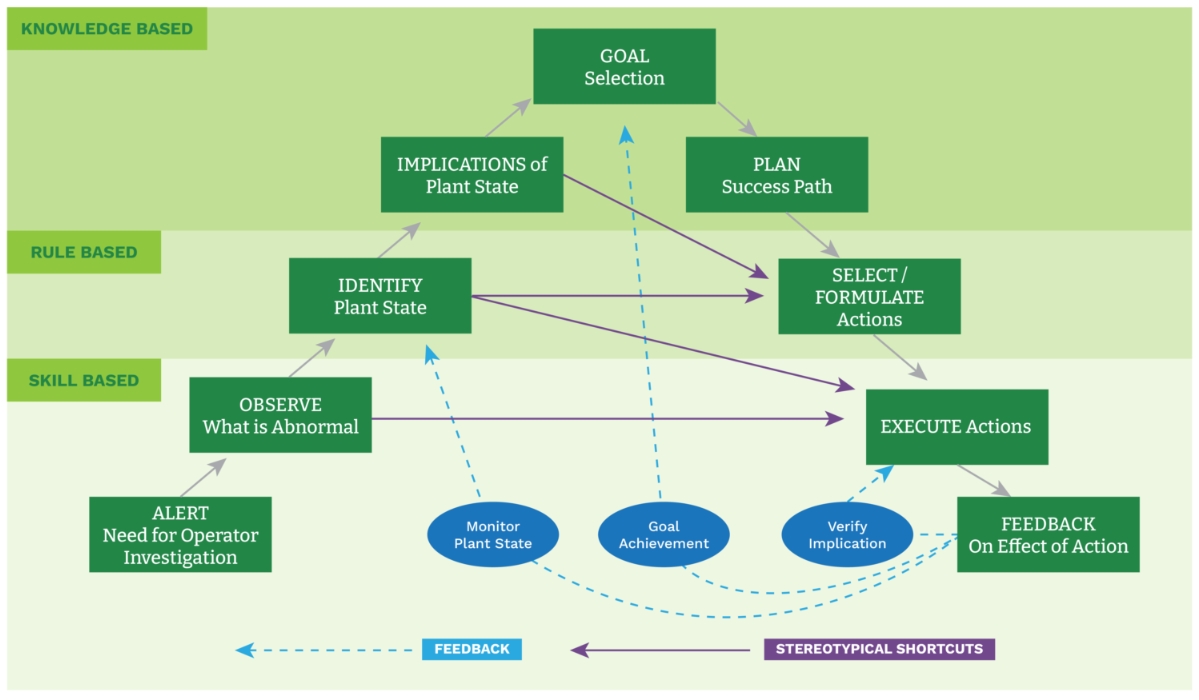
Source: James Reason’s interpretation of Rasmussen’s 1986 SRK framework of conceptual model of the sensemaking cycle.
Human performance modes and cognitive demand
Understanding sensemaking requires an appreciation of how cognitive effort varies across tasks. Jens Rasmussen’s Skills–Rules–Knowledge (SRK) framework remains one of the most practical ways to describe this variation.
Skill-based performance dominates routine, well-practiced activities. Actions are largely automatic, requiring little conscious attention. Errors at this level tend to be slips or lapses, such as selecting the wrong control or omitting a familiar step.
Rule-based performance comes into play when a situation is recognized as familiar but not routine. Stored rules or procedures guide action. Errors often occur when the situation is misclassified and the wrong rule is applied.
Knowledge-based performance is required when situations are novel or ambiguous and no established rules apply. Individuals must reason from first principles, drawing on mental models and incomplete information. Cognitive load is highest in this mode, and errors reflect gaps or inaccuracies in understanding.
VUCA conditions push work toward rule-based and knowledge-based modes more frequently. For less experienced personnel, this means sustained high cognitive demand and fatigue. For experts, the risk lies in confident misdiagnosis and inappropriate rule application, as illustrated in well-documented incidents such as the Three Mile Island accident, where conflicting cues and procedures overwhelmed operators.
Performance mode is not a fixed attribute of a person or a role. Individuals can move between modes multiple times during a single task. This reality explains why training and procedural compliance, while necessary, are insufficient on their own. Systems must be designed to support people across all modes, including clear feedback, accessible expertise and mechanisms to manage cognitive load.
Psychological safety as an operational enabler
Sensemaking and performance modes describe how people adapt. Psychological safety determines whether that adaptation is visible, shareable and improvable.
Psychological safety refers to a shared belief that it is acceptable to speak up, ask questions, admit uncertainty and challenge assumptions without fear of blame or reprisal. Research led by Amy Edmondson and reinforced by large-scale studies such as Google’s Project Aristotle demonstrates that psychologically safe teams outperform others in complex, interdependent work.
For safety-critical operations, the implications are direct. When people do not feel safe to voice concerns, they withhold information, conceal near misses and adhere rigidly to procedures even when those procedures no longer fit the situation. Learning slows, and weak signals are missed.
Conversely, teams with strong psychological safety are more engaged, show lower turnover intention and contribute discretionary effort beyond minimum requirements. These outcomes are not incidental benefits. They are indicators of an organization’s ability to learn faster than conditions change.
Psychological safety enables bottom-up learning, which is essential in complex systems where central oversight cannot see every local interaction. It supports inclusion, experimentation and timely escalation of concerns, all of which underpin operational resilience.
Building psychological safety through everyday practice
Psychological safety cannot be installed through policy alone. It is shaped through daily interactions and reinforced by leadership behavior.
Leaders play a critical role by modeling humility and curiosity. Practices such as humble inquiry, asking genuine questions and acknowledging uncertainty signal that learning is valued over appearing infallible.
Organizations can also expand their learning lens by studying normal work, not just incidents. Examining how people routinely adapt to keep operations running safely reveals where capacity exists and where it is being stretched.
Clarifying goals rather than prescribing only tasks further supports adaptation. When people understand what success looks like and why it matters, they are better equipped to adjust intelligently when conditions change.
Finally, encouraging voice requires visible reinforcement. When concerns are raised, they must be acknowledged and acted upon where possible. Over time, this builds the four progressive stages of psychological safety: inclusion, learner, contributor and challenger safety.
Integrating sensemaking, performance and culture
Sensemaking, human performance modes and psychological safety are not independent levers. They reinforce one another. Sensemaking allows people to interpret uncertainty. Performance modes explain the cognitive demands involved. Psychological safety ensures that insights, doubts and adaptations are shared rather than hidden.
Together, they define a resilient organization: one that recognizes variability as a reality to be managed, not an anomaly to be eliminated; one that designs systems to support human performance under pressure; and one that treats learning as an operational priority.
Practical implications for safety leaders
Several implications follow for organizations seeking to build safety capacity under VUCA conditions:
 Prioritize adaptability alongside compliance. Procedures remain essential, but they should support informed judgment rather than constrain it.
 Design for cognitive reality. Tools, interfaces and staffing models should account for shifts in performance mode and cognitive load.
 Invest in psychological safety as a core capability. Culture directly affects the quality and timeliness of information available for decision-making.
 Learn from everyday work. Understanding how success is achieved under normal variability provides stronger insight than focusing solely on failure.
VUCA is not a temporary phase. It is the context in which modern operations will continue to evolve. Safety, therefore, cannot be treated as a fixed target. It must be cultivated as a dynamic capacity, grounded in human performance, strengthened by culture and aligned with the realities of work as it is actually done.
Next steps: To explore how sensemaking, human performance and psychological safety can be embedded into your safety management system, connect with our specialists or explore our related insights on adaptive safety and operational resilience.
 Brian M. Wilson, M.S., CSP
Brian Wilson is a seasoned process safety expert with over 17 years of experience implementing proactive safety protocols in complex industrial environments. Currently serving as Global Director of Programs and Process Safety at Montrose Environmental Group, he leads comprehensive safety strategies across six divisions. Brian holds a Master of Science in Environmental Management and is a Certified Safety Professional (CSP).
Recognizing the role of human performance on process safety led Brian to study CCPS, DOE, IAEA, IChemE, and numerous authors focused on the subject of Human and Organizational performance, Safety Differently, Safety-II, and Resilience Engineering. Most recently this led to starting a Safety Leadership Graduate Certificate program led by Sidney Dekker.