
A Smarter Approach to Methane Management in Wastewater Treatment Plants
April 6, 2026
By: Elizabeth McGurk, Ed Capozzi & Justin Valle
With better visibility into emissions, operators can act on high-impact leaks, reduce odor and strengthen maintenance outcomes
Key takeaways
- A small number of high-rate leaks often drive a disproportionate share of total emissions
- Source detection and quantification can shift maintenance from reactive work to targeted fixes with impact across emissions, odor and operational efficiency
- Voluntary OGI surveys give wastewater operators a practical way to find, document and act on fugitive methane without major disruption
Methane emissions may be slipping by undetected
Wastewater treatment plants (WWTPs) with anaerobic digesters are designed to capture methane generated from the process. Most facilities measure methane they collect, but fewer measure what escapes as unintended emissions.
That means that operators are often focusing on mitigation efforts in the wrong places.
Voluntary optical gas imaging (OGI) leak detection surveys show that leaks occur across valves, connectors, tank hatches and piping, but only a subset meaningfully affects total emissions. These higher-impact leaks often persist because they are not usually required to be measured.
When those leaks are identified and repaired, facilities can reduce emissions faster, improve odor conditions and make better use of maintenance resources.
Leading operators detect emissions, even when it is not required
Operators are beginning to put more emphasis on source-level methane measurement, not because it is required, but because it is improving environmental impact and operational outcomes.
Source measurement strengthens greenhouse gas (GHG) inventories by replacing assumptions with site-specific information. It also helps facilities confirm whether repairs and operational changes are reducing emissions over time.
The same leaks that release methane also often drive odor. When those leaks are identified and repaired, facilities can reduce odor complaints and the repeat follow-up work that comes with them.
Direct measurement also improves maintenance planning. Common leak points, including valves, flanges, threaded connections and tank hatches, are already part of routine plant work, but now operators can prioritize resources based on impact.
Voluntary best management practice (BMP) surveys give facilities a structured way to find, document and act on these leaks without unnecessary downtime.
What drives emissions, and what does not
Across surveyed WWTP sites, emission sources differ in both frequency and impact.
Connectors appear often but typically release smaller volumes. Valves, while fewer, consistently produce higher emission rates and contribute a disproportionate share of total methane loss.
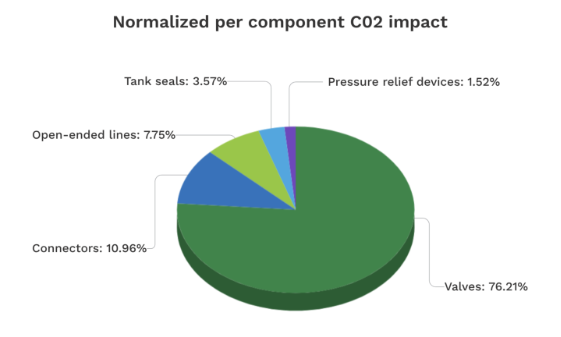
* Based on qualitative OGI and quantitative Hi-Flow measurements collected to date across 4 WWTPs.
Armed with the data from these voluntary surveys, operators can be much more precise and efficient with mitigation efforts. Fixing one high-rate valve leak can reduce emissions more than addressing multiple low-rate connector leaks.
These same higher-rate leaks are often linked to odor, so targeted repairs improve both emissions management and community impact.
Turning methane detection into efficient mitigation
To act on high-impact leaks, facilities need a way to find and document them without disrupting operations. This is where OGI survey programs shine.
A typical program includes:
- A short planning step to define scope, priority equipment and walking path
- A full optical gas imaging (OGI) survey, often completed in less than one day
- Leak tagging with photo and video documentation for precise follow-up
- Optional quantification using tools, such as the SEMTECH HI-FLOW 2 sampler
All findings are compiled into a centralized dashboard that shows each leak, where it is and how large it is. Maintenance teams can return to exact locations and complete repairs without repeat field investigation.
What changes when high-impact leaks are detected and repaired
Facilities that conduct BMP surveys to detect and quantify fugitive methane are a clear example of how environmental programs can have an outsized operational and reputational impact.
- Repairs focus on the sources that drive total emissions
- Crews spend less time locating issues and repeating work
- Odor conditions improve alongside emissions reductions
- Documentation supports communication with regulators and nearby communities
Over time, recurring surveys highlight where leaks recur, allowing facilities to address underlying issues rather than repeat the same fixes
Making methane measurable and manageable for WWTPs
Methane emissions at WWTPs are not evenly distributed, and they are not always visible through routine monitoring.
OGI surveys may not be required by law yet, but they provide the clarity needed to reduce emissions, improve maintenance efficiency and address odor at the source.
And when combined into a holistic strategy, that looks at water treatment, PFAS management, leak detection and emissions management programs, operators can create an environmental strategy built on resilience and reliability.
Contact us to see how OGI methane detection can identify high-impact leaks for wastewater treatment plants.
 Elizabeth McGurk
Methane Sector Leader
As Montrose Environmental’s Methane Sector Leader, Elizabeth leads complex, cross-disciplinary initiatives focused on methane quantification, mitigation, and regulatory strategy. With thirteen years of experience in air quality consulting—specializing in oil & gas and GHG accounting—she brings deep technical insight and a passion for data-driven emissions reduction. At Montrose, she guides global OGMP 2.0 initiatives, designs measurement pilots aligned with the revised U.S. EPA Subpart W rule, and delivers impactful training on methane management and the current regulatory environment. Elizabeth also contributes to the IOGP working group developing ISO standards for EU Methane Regulation compliance, helping shape the future of methane management worldwide.
 Ed Capozzi
Business Development Manager
Ed is a Business Development Manager for Montrose Environmental’s LDAR team, specializing in emissions compliance solutions, Optical Gas Imaging (OGI), and regulatory-driven leak detection programs. With a background in Saas, IoT, automation, and industrial services, Ed brings a strategic, data-driven approach to helping clients navigate complex compliance challenges. With over a decade of experience, Ed has a proven track record of building lasting client relationships. His expertise spans LDAR compliance, emissions testing, and environmental regulations, making him a valuable resource for industries seeking to optimize their compliance programs.
