
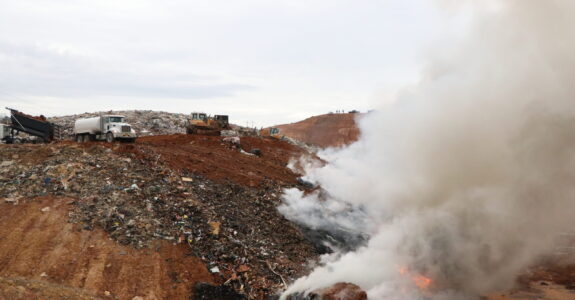
Why Landfills Are Now Central to the PFAS Conversation
April 6, 2026
By: Kyle Lapic
Landfills are passive receivers of PFAS, but managing it requires an active strategy
Landfills do not generate PFAS, yet they are responsible for managing its impacts.
For decades, landfills were designed to contain waste and control familiar risks. Today they sit at the center of the PFAS lifecycle, not because they create the problem, but because nearly all of it eventually arrives at their facilities.
This is not just a technical issue. It is a public perception issue that directly impacts a landfill’s license to operate. As communities, regulators and the media look more closely at PFAS, the steps operators take to measure, mitigate and disclose now shapes community trust, permitting success and long-term asset value.
Landfills have become aggregation points for PFAS embedded in consumer products, industrial materials, construction debris and municipal waste, but these sites were not designed or equipped to handle these new, complex chemicals. The science surrounding these persistent chemicals continues to evolve, but operators are being held accountable today because of the growing attention PFAS has gained both nationally and locally.
The challenge landfill operators now face is not limited to compliance with a specific regulation. It requires rethinking how landfills have fundamentally operated for decades. PFAS scrutiny will only continue to rise, and although landfill infrastructure was never designed to manage these chemicals, landfills are now widely viewed as the end of the line.
Why the PFAS spotlight is getting brighter for landfills
The increased focus on landfills is the result of multiple converging forces that have been building over time.
Public perception was an early driver of this shift. PFAS has become shorthand for long-term health risk. Media coverage focuses on drinking water contamination, firefighting foams and consumer exposure and even though landfills are not the original source, they are where many of these chemicals ultimately end up. That perception as a “PFAS hub” is directly affecting community reputation, inspection scrutiny and permit outcomes.
State regulations have escalated to meet public perception. Federal standards remain uneven, so states are moving at different speeds and in different directions. California set a high bar with additional monitoring and a lower tolerance for uncertainty. Other states are following with their own thresholds, testing mandates and reporting expectations. For multi-state landfills, this patchwork of regulations is more than just a compliance challenge. It creates a different playbook for every state that impacts cost, compliance and public relations.
Litigation and enforcement has expanded. PFAS lawsuits no longer stop with manufacturers. As science evolves, responsibility is being framed across the material lifecycle. For landfills, that means acceptance, disposal, sampling, monitoring and data quality can all become part of a future legal record. Perception of proactive diligence now matters as much as technical compliance.
Advances in monitoring and analytical technology have significantly increased visibility. Drones, advanced air sampling and lab methods capable of detecting PFAS at ultra-low concentrations have dramatically increased visibility. Better data is valuable, but it also raises expectations. Communities and regulators now ask questions operators were never required to answer before and managing this level of data was never part of a traditional landfill operators’ job description. This does not indicate that landfills have become inherently riskier. But it does mean that landfills are now expected to fulfill a strategy that has simply never existed before.
How PFAS actually moves through a landfill
PFAS breaks many of the assumptions landfills were built around. These are persistent, mobile chemicals that move across multiple pathways.
Leachate: Familiar but not the whole story
Leachate is where the PFAS conversation started. The concept is relatively simple, mitigation less so. When it rains, that water interacts with waste, which contaminates the water; it can then move off-site through a number of pathways and ends up in drinking water.
Because of that direct link to the public, leachate is comparatively well studied and there are a number of treatment solutions designed to mitigate that. But leachate is not the whole story.
Landfill gas: An emerging opportunity
Landfill gas is gaining attention for PFAS as a result of expanded monitoring and analysis. Gas has always been thought of as methane and methane capture and reuse became an efficiency push for many landfills.
However, the more gas that was captured and reused, the more compounds, like PFAS, were found. Flares, collection systems and gas-to-energy infrastructure were built to manage methane and traditional volatile organic compounds (VOCs), not PFAS.
Gas-to-energy projects will continue, but as measurement improves, questions multiply. In some cases, better measurement brings clarity, in others, it can reveal previously unrecognized risks, finding issues landfills were not set-up to manage. Either way, the court of public opinion and regulators, expect that mitigation strategies keep up with measurement advances.
How should landfill operators respond?
The implications of this are not theoretical. Increased scrutiny is already affecting day-to-day operations and long-term planning.
Operators do not need to solve PFAS in isolation and they do not need to wait for final federal direction to act. EPA’s updated guidance on destruction and disposal of PFAS and PFAS-containing wastes provides an important reference point for evaluating current practices and identifying where additional controls or data may be warranted. Reviewing that guidance in the context of site-specific operations can help pressure-test assumptions and prioritize next steps. See EPA’s updated guidance overview here.
Some operators are adjusting course proactively. They are treating PFAS understanding as a core part of their long-term license to operate, not an added compliance cost. Sites that build defensible baselines, connect their monitoring across pathways and communicate clearly tend to retain more flexibility as rules evolve.
PFAS will remain a long-term management risk. But just because it is something that landfills have to manage does not mean that there isn’t opportunity to be found.
Operators who invest in a system-level strategy, bringing leachate, gas, methane and other siloed programs into a holistic view, gain meaningful operational and strategic advantage They can answer hard questions with evidence, negotiate from a place of knowledge and shape regulatory and community perception.
Contact us to develop a proactive PFAS strategy that drives real operational value.
 Kyle Lapic
Solid Waste Sector Leader
Kyle Lapic serves as Solid Waste Market Sector Leader at Montrose, bringing more than 15 years of experience in environmental compliance, permitting, and regulatory strategy. His work focuses on the solid waste industry, where he supports landfill operators, waste companies, and industrial clients navigating complex federal and state environmental requirements.
Kyle has extensive experience with permitting and compliance programs under 40 CFR RCRA hazardous and solid waste regulations, as well as SPCC and SWPPP requirements. He works closely with major waste companies including Waste Connections, Waste Management, and Republic Services to address evolving regulatory challenges and operational needs.
Kyle’s work centers on helping clients solve complex environmental challenges through practical, defensible solutions that support long-term regulatory compliance and operational performance.
