

Battery Storage Is Becoming the Grid’s Reliability Backbone
February 11, 2026
By: Heather Patti
Drawing on insights from PowerGen 2026, Renewable Energy Services Lead Heather Patti reflects on the evolution of battery energy storage. Rising, always-on load is tightening reliability expectations, and battery storage is moving from an “add-on” to foundational grid infrastructure, shaping the next generation of projects for utilities, energy developers, and grid stakeholders.
Key takeaways
- Speed is a primary advantage: battery storage systems can respond in tens of milliseconds, supporting grid stability during rapid load and frequency events.
- Short-duration BESS solves the daily operating problem: four-hour class systems support intraday variability, peak shaving, and routine grid services.
- Longer-duration systems extend coverage when conditions stretch: DOE defines long-duration storage as 10+ hours, enabling longer reliability support and resilience through extended supply gaps.
Rising demand is reshaping power generation priorities
Power generation is facing escalating pressure as load grows and performance expectations rise. Data centers, electrification, and extreme-weather risks are converging on the same outcome: around-the-clock availability is becoming a baseline requirement.
That reality surfaced repeatedly at PowerGen 2026, where sessions emphasized reliability, resilience, and delivery speed as defining constraints for the next wave of projects.
Why BESS has become foundational to the grid
BESS now functions as the grid’s flexibility layer, balancing supply and demand faster than conventional generation can ramp.
Short-duration BESS can charge and discharge in fractions of a second, which is well-suited for intraday variability and sudden load spikes.
Longer-duration systems extend that capability, storing excess energy during high production periods and releasing it when generation drops or demand peaks. This expands storage from fast-response support into longer-window reliability planning.
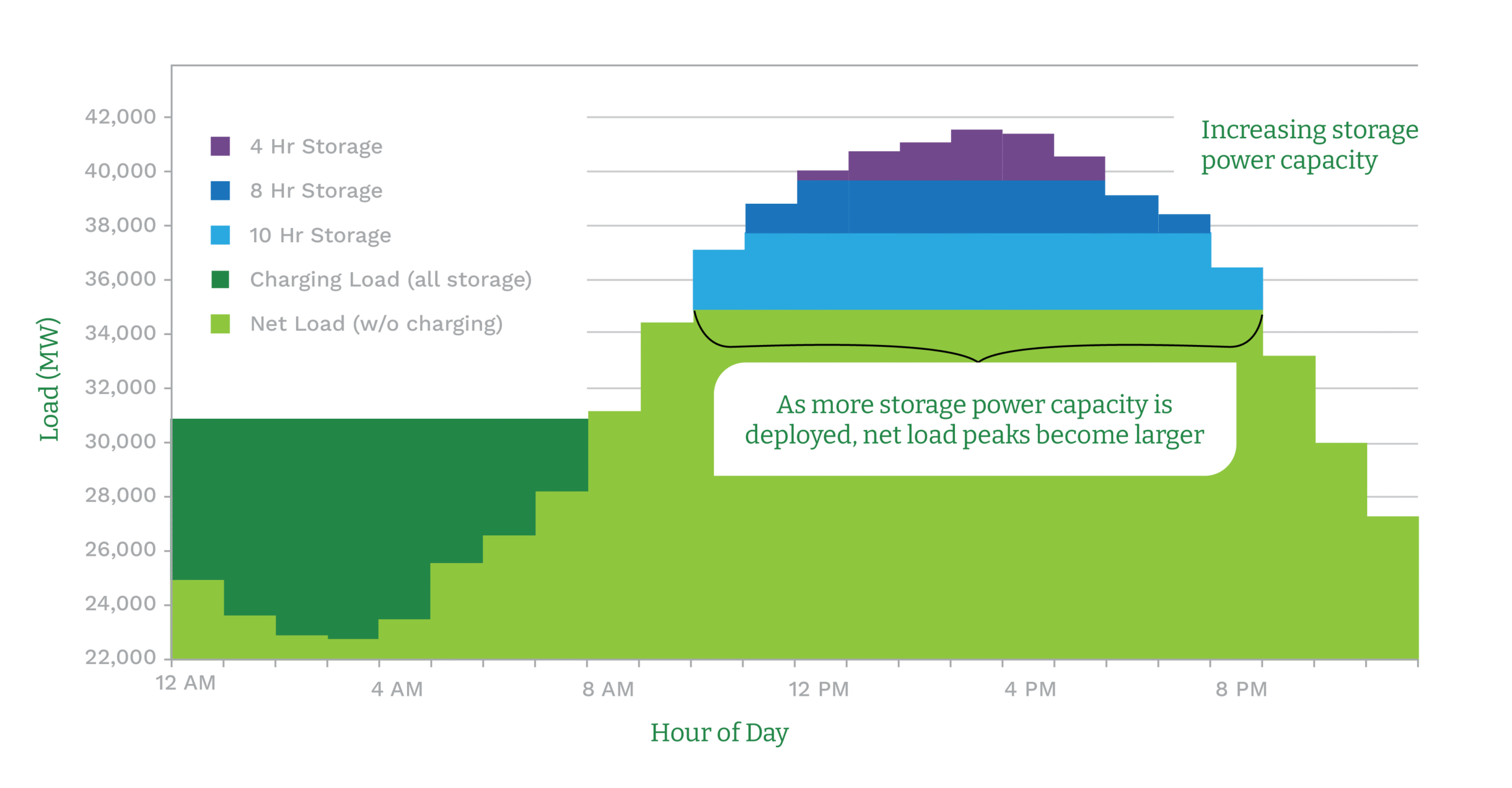
Source: Denholm, Paul, Wesley Cole, A. Will Frazier, Kara Podkaminer, and Nate Blair. 2021. The Challenge of Defining Long Duration Energy Storage. Golden, CO: National Renewable Energy Laboratory. NREL/TP-6A40-80583.
What is accelerating deployment
Several drivers are converging:
- Reliability and resilience: storage provides fast-response support that traditional generation alone cannot match
- Data centers and other continuous-load users: operations require immediate response to disruptions and increasingly value on-site and grid-supporting storage
- Deployability and flexibility: modular systems can be scaled, configured, and co-located with renewables, gas, and existing infrastructure
Policy signals continue to reinforce storage’s role. Many states have adopted formal targets and related procurement frameworks, and Clean Energy States Alliance tracks state energy storage targets.
Long-duration storage is expanding the grid’s options
Long-duration energy storage is generally discussed as systems capable of 10+ hours of discharge. That category is gaining attention for its ability to support grid flexibility through longer events, including extended outages, prolonged low renewable output, or sustained demand peaks.
PowerGen discussions reflected growing activity across electrochemical, thermal, and mechanical pathways, along with a shared message: scaling long-duration systems depends on collaboration across utilities, technology providers, regulators, and delivery partners to align safety, permitting, and operational expectations.
Regional context still determines what works
PowerGen reinforced that BESS is not one-size-fits-all. Interconnection requirements, market structures, climate, load shape, and incentives vary widely. A system optimized for ERCOT may not perform or monetize the same way in PJM.
Co-development reduces risk and compresses timelines
Storage performs best when it is planned alongside generation and interconnection, not bolted on late. Co-developing short- and long-duration systems, or pairing storage with renewables and conventional assets, can shorten timelines and create more resilient operating profiles.
Beyond the US: how Montrose supports real-world delivery
Queensland, Australia: Darling Downs BESS (Origin Energy)
Montrose’s Australia team supported the project by completing ecological surveys and impact assessments aligned with Commonwealth environmental legislation. The approximately 40-acre site includes an open-air BESS facility connected to an existing substation via a 275 kV transmission line. Montrose identified ecological considerations early and integrated them into site planning to reduce approval risk for a strategic storage asset.
Alberta, Canada: Jurassic Solar + BESS (near Iddesleigh)
Montrose supported site selection and permitting for a 220 MWac solar facility paired with an 80 MW / 160 MWh battery system. Work included baseline field surveys across wildlife, vegetation, and wetlands, including sensitive species considerations. Montrose prepared the Renewable Energy Project Submission and compiled environmental components for regulatory applications, supporting compliance while keeping development aligned with schedule needs.
Actions for energy developers who deal with short- and long-duration BESS
- Define the operating need: peak shaving, backup power, load shifting, or grid services
- Match duration to risk: short-duration for daily operations, long-duration where 10+ hours of discharge drives reliability value
- Plan storage with the asset: integrate safety, controls, interconnection, and permitting early
- Build the delivery chain: long-term performance depends on design choices and execution discipline
Explore related content
We’re excited to continue this work with our clients and partners in the year ahead. If you’d like to explore how we can support your energy strategy, we’d love to connect.

Top Takeaways from RE+ International

Responsible Development for Alberta’s Future
 Heather Patti
Senior Associate / Renewable Energy Services Lead
With over two decades of experience, Heather is a highly skilled expert in the fields of botany, ecology, and renewable energy project support. Specializing in renewable energy project management, wetland delineation, expert witness testimony, rare species surveys, and ecological restoration, she has made significant contributions in her current role as a Senior Associate at Montrose. Throughout her career, Heather’s work has been pivotal in protecting and preserving natural habitats and managing wetland delineation projects. Heather holds a Master of Science (MS) degree in Botany and Ecology from North Carolina State University and a Bachelor of Science (BS) in Biology and Chemistry from the University of North Carolina Wilmington.
