
Brownfields 2025 State of the Union: A New Landscape of Environmental Policy
August 25, 2025
By: Chris Gdak and Derek Street
2025 has brought seismic changes to the U.S. Environmental Protection Agency’s (EPA) Brownfields and Environmental Justice (EJ) programs. Significant policy shifts and agency restructuring under the new administration, communities, consultants, and local governments are now facing a dramatically altered landscape. As seasoned professionals in the field, we’re offering key insights to help developers navigate the current regulatory environment and stay ahead—by understanding the past that shaped it, the present we’re reshaping, and the uncertain path ahead.
A Brief History of Brownfields and EJ at EPA
The EPA’s Brownfields Program was established in the mid-1990s and evolved into a cornerstone of community revitalization. Through the Multipurpose, Assessment, Cleanup, and Revolving Loan Fund (MARC) grants, the EPA has helped transform contaminated, underused sites into assets for local economies.
Parallel to this, the Environmental Justice Program emerged to empower historically marginalized communities burdened by pollution and disinvestment. Beginning in 1994, early EJ efforts included small grants for community education and collaborative problem-solving. By the late 2000s, these expanded to include government-to-government grants to institutionalize EJ principles in public agencies.
Between 2021 and 2024, support for brownfields and environmental justice reached historic highs under the previous administration. Signed into law in November 2021, BIL allocated $1.5 billion for brownfields alone—the most significant single investment in addressing legacy pollution in U.S. history. EPA used this funding to:
- Quadruple annual grant funding over five years
- Triple the maximum amount for cleanup grants, from $500K to $5M
- Prioritize awards to Environmental Justice communities
In August 2022, the IRA dedicated $26 billion to environmental justice. It established new initiatives such as:
- Thriving Communities Technical Assistance Centers (EJ TCTAC) – $177M awarded in 2023
- Thriving Communities Grantmaking (EJ TCGM) – $550M awarded in 2023
- Environmental and Climate Justice Change Grants – $2B starting in fall 2024
Tools like the EJScreen and CDC’s Public Health Tracking Network were also improved, empowering communities with data to support local action.
These years marked a transformative period by every measure. But 2024 marked the beginning of a new chapter.
Shifting Priorities: Changes in Brownfields and EJ Policy
On January 20, 2025, the incoming administration issued executive orders pausing the disbursement of Inflation Reduction Act (IRA) and Bipartisan Infrastructure Law (BIL) funds. A subsequent memorandum from the Office of Management and Budget (OMB) temporarily halted federal assistance. Although the courts later lifted the pause, these actions marked the beginning of a broader shift in federal policy direction.
Within six months, the following major changes were underway:
- EPA reorganization and workforce reductions
- Dissolution of the Office of Research and Development
- Termination of the Office of Environmental Justice and External Civil Rights
- Elimination of over $2.7 billion in climate and EJ grants
- Executive actions halting EJ grant programs and defunding diversity initiatives
- A proposed 55% cut to the EPA budget in the FY2026 Presidential Budget request
- Elimination of the EJ Screen Mapper and Climate and Economic Justice Screening Tool (CEJEST)
These shifts align with the administration’s “Powering the Great American Comeback” agenda, emphasizing deregulation, energy dominance, and permitting reform.
Perhaps the most impactful piece of legislation to date, the “One Big Beautiful Bill” rescinds unobligated IRA funds, including:
- Environmental and climate justice block grants
- Climate-related data initiatives
- EV and renewable energy tax credits
Notably, BIL funding for brownfields remains intact, offering continued opportunities — particularly for those able to act swiftly.
On February 5, 2025, bipartisan support emerged when the Senate Committee on Environment and Public Works unanimously passed the Brownfields Reauthorization Act. Key provisions include:
- Increased cleanup grant cap from $500K to $1M
- Reduced cost-sharing from 20% to 10%
- Annual appropriations of $200M through 2030
- Specific focus on rural and small communities
- Inclusion of 501(c)(6) organizations
- Exemption of brownfield grants from secondary spending approval thresholds
While this provides some long-term stability, it does not fully mitigate the effects of broader fiscal and structural changes at the EPA.
2025 Grant Winners
In May 2025, EPA announced its FY2025 brownfield grant awards.
- Assessment Grants: $121.8M
- Cleanup Grants: $88.2M
- Revolving Loan Fund (RLF) Grants: $15M
- Total Success Rate: 45%
Changes to EPA Environmental Justice Programs
The restructuring of EPA’s Environmental Justice offices has unfolded rapidly:
- January 20, 2025
Executive Order
 Executive Order halts all IRA and EJ funding.
 - February 6, 2025
EPA Staff Reduction
 Approximately 170 EJ and DEI staff are placed on leave.
 - March 12, 2025
Environmental Justice Dissolution
 The official dissolution of EJ offices is announced.
 - March 15, 2025
Grants Terminated
 Over $2.7 billion in climate and EJ grants are terminated.
 - June 18, 2025
Federal Ruling
 A federal judge rules that $600 million in canceled grants was unlawful.
 - June 25, 2025
Class Action Lawsuit
 A class action lawsuit is filed regarding $1.7 billion in canceled EJ grants.
 - June 30, 2025
EPA Employees' Letter
 Nearly 300 EPA employees sign a public letter expressing concerns about the changes.
The implications are significant. Communities face not only the loss of essential funding but also the potential erosion of trust and relationships that have been built over many years.
Looking Ahead: What to Expect in FY2026 and Beyond
With BIL funding still available, FY2026 may represent one of the final years with enhanced brownfield funding levels.
Highlights include:
- No-match cleanup and multipurpose grants
- Assessment grants up to $2M; cleanup up to $4M
- Guidelines released: September 2025
- Submittals due: Late October or early November
- Awards announced: May 2026
Applicants should not wait. The FY2026 cycle is an opportunity to benefit from the surge in funding made possible by the Bipartisan Infrastructure Law.
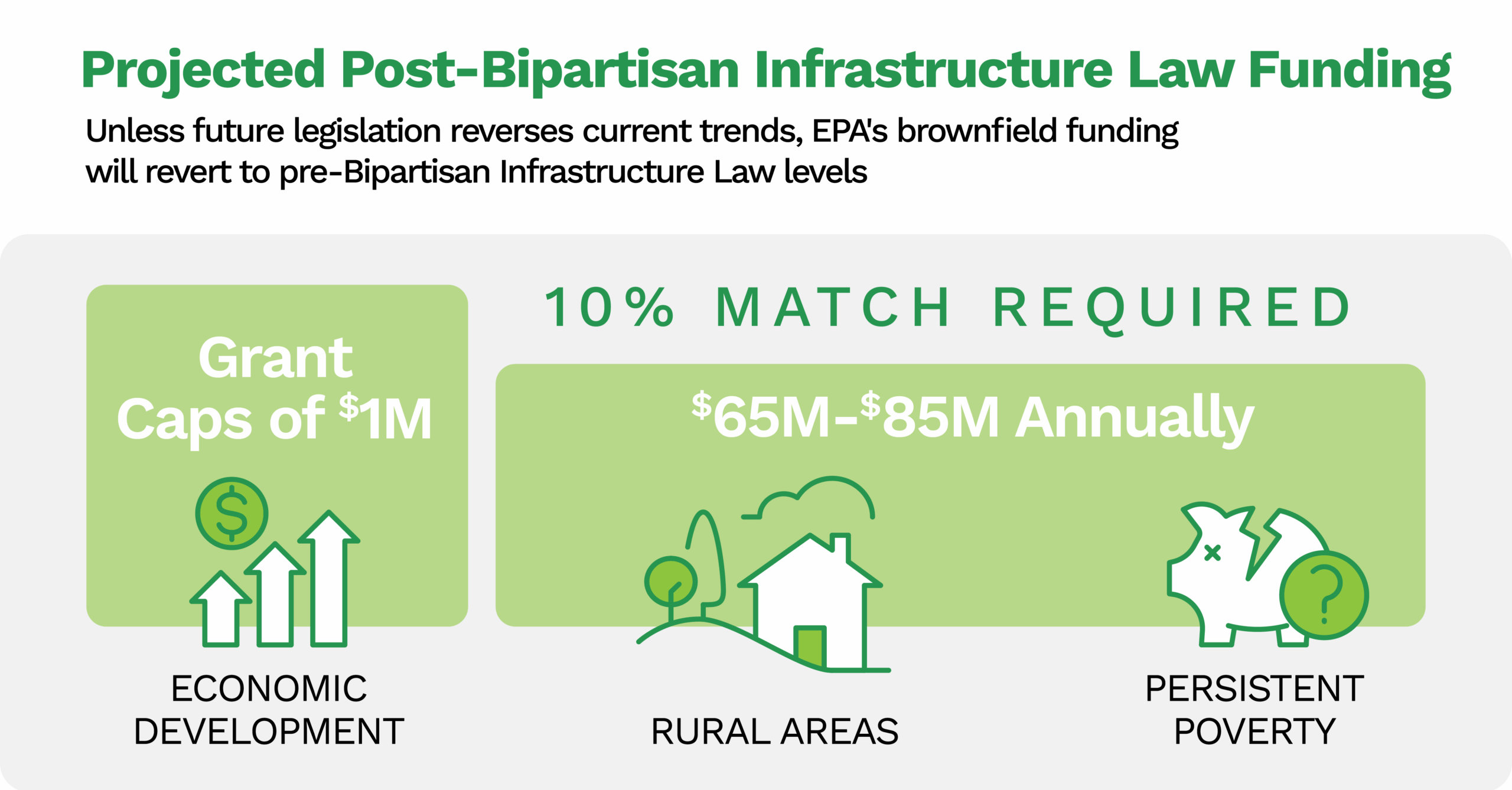
With EJ-specific funding unlikely to return, applicants are encouraged to align proposals with broader themes such as economic hardship or environmental degradation to remain competitive.
Final Thoughts: Adapt, Advocate, Act
For communities, tribal governments, nonprofits, and consultants working in this space, the message is clear: act now and prepare for a leaner future.
If your community has EJ priorities, whether it’s a legacy landfill, abandoned industrial corridor, or contaminated tribal land, this next round may be your last best chance to fund brownfield revitalization at historic levels. However, it will likely require adapting to using economic language to reach the same ends.
We at Montrose Environmental Group are here to help you navigate the shifting landscape. With projects in all 10 EPA regions and clients from Alaska to Maine, we specialize in building and executing grant-winning programs precisely.
Together, we can continue to push forward because even in uncertain times, revitalization is possible.
 Derek Street
Principal Geologist, Brownfields & Community Revitalization Practice
Derek Street is an environmental professional with deep experience in site assessments, brownfield redevelopment, and regulatory compliance. He has worked both in the private sector and at the USEPA, where he reviewed and enforced AAI standards for federal brownfield funding.
 Chris Gdak
Practice Leader for Brownfields & Community Revitalization
Chris brings 22 years of environmental consulting and brownfield redevelopment experience to his role as Montrose’s Brownfields & Community Revitalization Practice Leader. Chris focuses on assisting municipal, tribal and community-based organizations with building successful programs to achieve their goals. He has assisted clients in over 20 states and has enjoyed learning about each community’s needs and opportunities, developing relationships with local stakeholders, and contributing to the restoration and revitalization of distressed areas.
